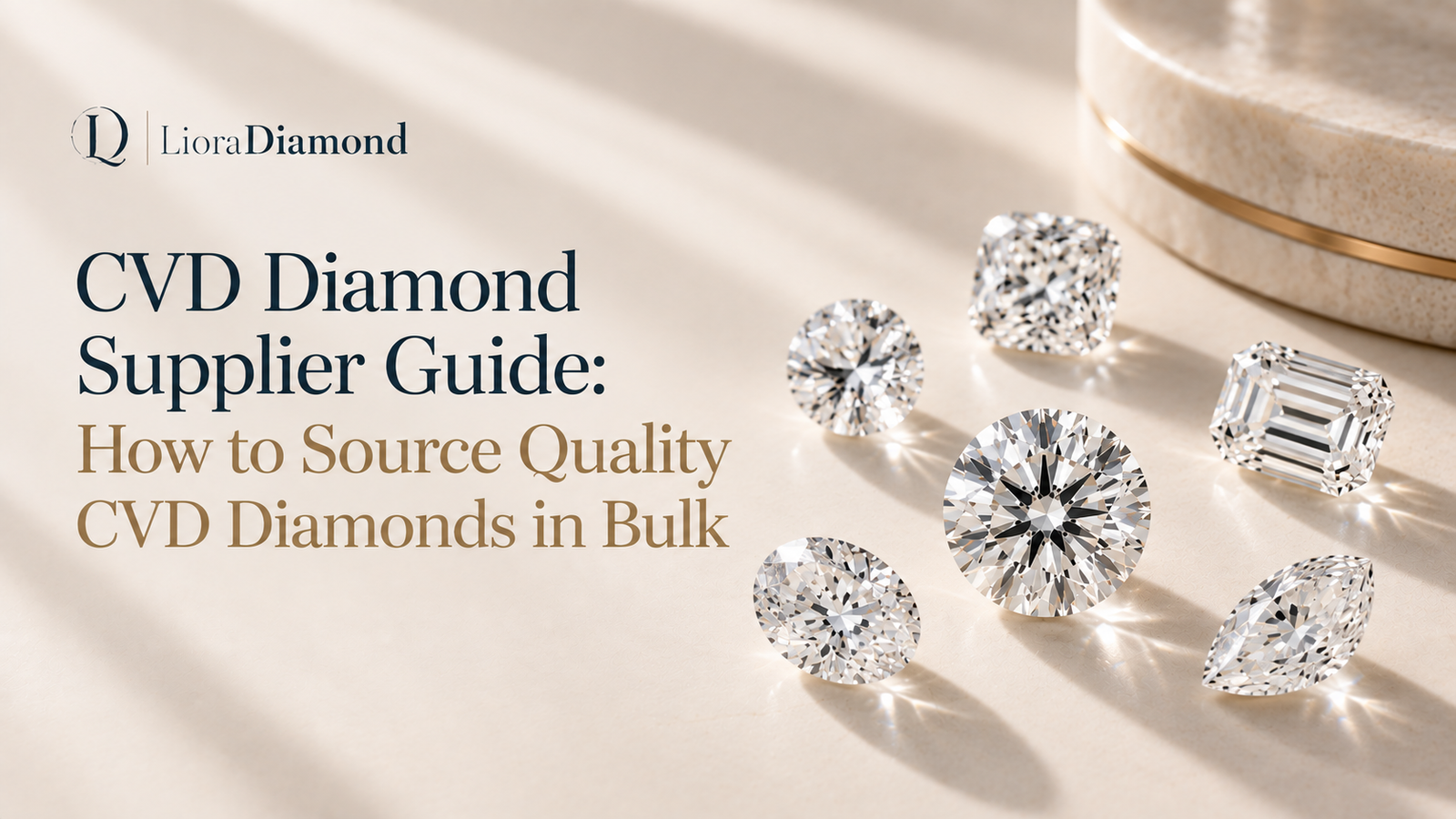
Looking for a reliable CVD diamond supplier? Let Liora Diamond help you. Discover how to source quality CVD diamonds in bulk, compare wholesale CVD diamonds, evaluate certification, pricing, and quality, and find a trusted CVD lab-grown diamond partner for global jewelry sourcing.
Sourcing CVD diamonds in bulk involves more variables than most buyers expect. Two parcels with identical 0.06 to 10 carat totals and grading reports can perform very differently on a jeweler's bench. A wholesale lab-grown diamond supplier that quotes the lowest price per carat isn't automatically the most reliable. For wholesalers, manufacturers, and retailers building recurring supply relationships, the choice of CVD diamond supplier determines consistency, margin, and how much rework happens after delivery.
This guide explains what CVD diamonds are, how to evaluate quality at the procurement level, and how to structure the sourcing process—from defining specifications to placing a repeat order—so you can select suppliers based on verifiable criteria rather than price alone.
What Is a CVD Diamond?
CVD diamonds are laboratory-grown diamonds produced through Chemical Vapor Deposition, a controlled process in which carbon-containing gases are used to grow diamond material on a diamond seed.
Inside a sealed chamber, a thin diamond seed plate is exposed to a carbon-rich gas mixture, typically methane and hydrogen. Microwave energy ionizes the gas into plasma, and carbon atoms deposit onto the seed layer by layer until a rough diamond crystal forms. The rough is then cut and polished using the same equipment and expertise used for mined diamonds.
Because the resulting stone has the same crystal structure, optical properties, and hardness as a natural diamond, it is classified and graded as a diamond — a laboratory-grown one, not a simulant such as cubic zirconia or moissanite. For B2B buyers, this distinction matters because CVD diamonds are graded on the same 4Cs framework used for natural stones. That means decisions can rely on familiar specification language.
Why Businesses Buy CVD Diamonds in Bulk?
Bulk CVD sourcing appeals to businesses for largely operational, rather than aesthetic, reasons:
1. Availability across a wide range of 0.05 to 30+ carat weights and shapes.
This makes it easier to plan inventory around known demand patterns, particularly for engagement rings, tennis bracelets, and stud earrings where matched stones are needed in volume. A retailer building out a shape assortment, for instance, typically needs reliable access to round, oval, cushion, princess, and emerald-cut stones from the same source, rather than fragmenting orders across multiple suppliers to fill each shape category.
2. Retailers are building lab-grown diamond collections for specific size and quality combinations.
Manufacturers producing private-label or white-label jewelry need matched parcels that hold consistent color and clarity across a production run, not just within a single order. Jewelry brands developing new product lines need custom specifications — including a defined carat range, a specific clarity floor, and a particular cut grade—that a supplier can source, rather than substituting whatever is in stock.
Some buyers also look for variety beyond standard white diamonds.
Fancy-color CVD stock is worth checking when a supplier's inventory extends to 5-carat yellow round cut, 5-carat pear-shaped fancy vivid brown, or 30-carat cushion pink lab-grown diamonds for differentiated product lines.
3. Pricing accessibility is part of the appeal.
But it should not be the only consideration. A wholesale lab-grown diamond supplier who can consistently deliver matched, correctly graded parcels on a repeat basis is generally more valuable to a growing business than one who offers a marginally lower quote on a single order.
What to Look for in a Quality CVD Diamond?
Quality evaluation for bulk purchasing should go beyond the headline grade on a certificate. Buyers need to check how each factor affects both the finished product and the inventory it will become part of.
| Quality Factor | What Buyers Should Check | Why It Matters |
|---|---|---|
| Carat | Weight and tolerance across the parcel | Affects inventory planning and matched-set consistency |
| Color | Grade consistency across stones | Determines product positioning and matching |
| Clarity | Inclusion type, size, and position | Affects visual quality and eye-clean appearance |
| Cut | Proportions, polish, and symmetry | Drives light performance and face-up appeal |
| Certification | Independent grading report | Confirms the stated specifications |
| Measurements | Length, width, and depth | Affects setting compatibility |
| Laser inscription | Matches the report number | Confirms stone-to-certificate identity |
Buying by carat price alone can be misleading.
Two one-carat, G-color, VS1 stones can look and perform differently depending on diamond cut quality grade and proportions. A well-cut stone with slightly lower clarity can outperform a poorly cut stone with a higher clarity grade, which is why cut and proportions deserve as much attention as carat and color during procurement.
Buyers focused specifically on larger center stones can narrow a supplier's catalog to 1-carat diamonds in bulk to compare proportions and grading within that range directly.
CVD vs HPHT: Which Is Better for Wholesale Buyers?
CVD and HPHT (High Pressure High Temperature) are the two production methods used to grow diamonds in a laboratory. Neither method is universally superior—the finished stone's specifications, grading, and consistency matter more than its growth method.
| Factor | CVD | HPHT |
|---|---|---|
| Production method | Carbon-rich gas deposited on a seed under plasma in a controlled chamber | Carbon subjected to extreme heat and pressure to replicate natural diamond formation |
| Typical sourcing considerations | Widely used for larger size ranges and post-growth color treatment | Often used for smaller melee and certain color treatments |
| Size availability | Broad range, including larger carat weights | Strong availability in smaller calibrated sizes |
| Color considerations | Post-growth treatment sometimes applied to adjust color | Post-growth treatment sometimes applied to adjust color |
| Best evaluated by | Grading report, cut quality and proportions | Grading report, cut quality and proportions |
The production method should not be the only purchasing criterion. Buyers evaluating CVD vs HPHT diamonds should request the grading report for each specific stone or parcel and compare actual specifications rather than assuming one method guarantees better outcomes than the other.
How to Choose a CVD Diamond Bulk Supplier
Wholesale lab-grown diamond supplier selection is where most procurement risk sits. The following checklist covers the criteria that matter most for a bulk buyer.
1. Certification and traceability
Confirm that stones come with certification reports from an independent laboratory such as IGI or GIA, and that report numbers correspond to laser inscriptions on the physical stones.
2. Product consistency
Ask for examples of matched parcels and compare stated specifications against physical inspection or third-party verification. This ensures the parcel you receive matches the supplier's offering.
3. Inventory capability
A supplier with visible, current stock is generally easier to plan repeat orders around than one working purely on make-to-order timelines.
4. B2B experience
Bulk lab-grown diamond suppliers with an established history of wholesale and manufacturing clients look to understand parcel matching, packaging, and documentation requirements better than those focused primarily on single-stone retail sales.
5. Transparent pricing
Lab-grown diamond pricing structure in B2B should be clear for parcel purchases, calibrated sizes, and custom specifications, without confusing or shifting terms.
6. Sample or parcel inspection
A supplier willing to provide samples or allow third-party verification before a large order signals confidence in their stock. This helps you check the reliability of the B2B lab-grown diamond manufacturer (if you’re sourcing directly from them).
7. Documentation
For wholesale lab-grown diamond purchases, include key documents such as commercial invoices, grading reports, and packing lists, and ensure they're complete and accurate for customs.
8. Shipping and logistics
When sourcing diamonds in bulk, insured, trackable international shipping reduces risk for high-value parcels. This matters when sourcing 100+ carats in different shapes and clarity, like VVS round, VS1 oval, Flawless princess, emerald in Internally Flawless, etc.
9. Communication
Response time and clarity during the quoting stage reflect how the relationship will function after the sale. This includes on-time communication about quotes, parcel tracking, and a smooth handover of the diamonds.
10. Repeat-order capability
Ask directly whether the diamond bulk order supplier can match specifications across future orders, not just the current one. This helps you manage the entire diamond parcel and consistently get quality stones.
How to Buy CVD Diamonds in Bulk: A Practical Sourcing Process
Step 1: Define your requirements.
Set a carat range (e.g., 0.30 to 30.00), shape (round or princess), color (D to J or fancy colors), clarity (FL to VVS), cut standard (Excellent to Very Good), and certification preference before contacting any supplier.
Step 2: Prepare an RFQ.
Put the requirements in writing so every supplier is quoting against the same specification.
Step 3: Shortlist suppliers.
Narrow the list to suppliers with relevant B2B experience and inventory that matches your specification.
Step 4: Compare quotes.
Evaluate the full commercial offer, not just price per carat. Manage this properly when buying lab-grown diamonds in bulk.
Step 5: Request certificates and stone details.
Ask for grading reports and, where possible, individual stone images or video before committing to quotes based on your requirements.
Step 6: Evaluate samples or parcels.
Inspect a sample order or have it verified independently before scaling to full volume. It reduces the chances of getting the wrong lab-grown diamonds in bulk.
Step 7: Confirm commercial terms.
Agree on payment terms, lead time, replacement policy, and shipping insurance in writing. This can help avoid issues with chargebacks, etc
Step 8: Place the order.
Confirm final specifications and quantities against the agreed RFQ. Get complete details regarding it before confirming the order to be supplied.
Step 9: Inspect goods upon receipt.
Check stones against certificates and packing lists before accepting the shipment. If the inspection is satisfactory, proceed; otherwise, reject the shipment.
Step 10: Review supplier performance before repeat orders.
Track consistency, accuracy, and communication to decide whether to scale the relationship. This can reduce the chances of trust issues and miscommunication.
What Should You Include in a Bulk CVD Diamond RFQ?
A detailed RFQ produces more comparable supplier quotations and reduces back-and-forth during negotiation. Include:
Shape
0.05 to 30-carat range
Color range (including bulk fancy color lab-grown diamonds)
Clarity range
Cut requirements
Polish and symmetry standard
Certification preference (IGI, GIA, or other)
Quantity
Target price range
Delivery destination
Required delivery date
Packaging requirements
Replacement or return expectations
Repeat-order requirements
Suppliers quoting against the same specification sheet are far easier to compare than suppliers each interpreting a vague request differently.
Common Mistakes When Sourcing CVD Diamonds in Bulk
1. Choosing solely on lowest price.
Buying stones in bulk without accounting for cut quality and consistency, which can create problems with shipment completion. Also, the business has to depend on after-sales support.
2. Buying without verifying certification.
A CVD diamond certificate is the most important way to determine whether a diamond is genuine or fake. It confirms that laser inscriptions match the report numbers.
3. Ignoring cut quality.
Diamond cut grade is usually required to inspect, with grades ranging from Excellent to Poor, which affects light performance more than most buyers initially assume.
4. Comparing stones only by carat.
Even if you're buying 30 carats in bulk, a 0.50-carat stone isn’t enough to focus on weight alone. Other factors like color, clarity, and proportions must be checked properly.
5. Failing to define specifications before requesting quotes.
First, the jewelry business must decide what quality CVD diamonds it needs, such as VVS clarity, round or emerald shapes, a total of 50 carat weight, or stones with an Excellent cut grade and IGI certification reports. If you haven't done so, those product quotes aren't comparable.
6. Ordering large quantities before testing a supplier.
You ordered a total 100-carat-weight shipment in bulk for the first time, and the supplier is unknown; that's strange. First, ask for a sample quantity or a smaller parcel of lab-grown diamonds; if everything meets the quality standards, go for the wholesale order.
7. Ignoring logistics and documentation.
If the lab-grown diamond supplier's logistics partner is unreliable, you may face delivery delays, which can lengthen the jewelry production lifecycle. Make sure the supplier is in contact throughout the customs clearance for a smooth handover of the shipment.
8. Not checking repeat-order consistency.
Since a strong first parcel doesn't guarantee the same quality on future orders, not checking whether a supplier is transparent in pricing for repeat orders to match quality standards, or focusing only on shipment handover, is a red flag.
9. Assuming every "certified" stone is commercially identical.
When grading ranges within a single grade can still vary in appearance. For example, a 1-carat VVS round cut diamond may appear different in VS1 clarity with a shallow or Very Good cut grade. Check the 4Cs, including symmetry and fluorescence grade, for the best wholesale diamond sourcing.
10. Failing to clarify treatment and disclosure information.
When getting a quote from a B2B lab-grown diamond supplier, ask directly whether post-growth color or clarity treatments have been applied. This reduces risk when stones are engraved in jewelry, and it helps the customer confirm the CVD diamond is genuine.
How to Compare CVD Diamond Supplier Quotes
Price per carat is only one line item in a commercial offer. A full comparison should weigh:
Price
Certification and verification options
Stone or parcel matching quality
Quantity available at the quoted specification
Lead time
Shipping and insurance terms
Documentation completeness
Payment terms
Replacement policy
After-sales responsiveness
A cheaper quote that lacks matching consistency, insured shipping, or a clear replacement policy can cost more in rework, delays, and customer complaints than a marginally higher-priced quote from a more consistent supplier. When comparing multiple options from the same supplier, it can help to review stock diamond prices sorted from lowest to highest price within your target specification, then check whether the lower-priced stones still meet your cut and clarity requirements before treating them as comparable to higher-priced alternatives.
Why Liora Diamond Can Be Considered for B2B CVD Diamond Sourcing
For buyers evaluating suppliers against the criteria above, CVD and lab-grown diamond sourcing is a core area for Liora Diamond, alongside natural diamonds and bespoke jewelry manufacturing. Liora Diamond currently offers GIA-certified diamonds with laser inscription, live inventory that buyers can review directly, and structured B2B parcel pricing.
We also support custom specification sourcing and make-to-order requirements for buyers who need a defined carat, color, or clarity combination rather than whatever is in stock, along with worldwide insured shipping and documentation suited to international B2B buyers. Buyers can browse the full range of certified loose diamonds, filter specifically for IGI-certified stock, or submit B2B sourcing requirements directly to compare specifications against their own RFQ.
Frequently Asked Questions About CVD Diamond Suppliers
1. How do I choose a reliable CVD diamond supplier?
Check independent certification, request samples before large orders, confirm inventory visibility, and review pricing transparency and shipping terms. Suppliers with established B2B experience and consistent repeat orders generally carry less procurement risk.
2. Can I buy CVD diamonds in bulk?
Yes. Many suppliers offer matched parcels, calibrated melee, and custom specification sourcing for bulk buyers, though minimum quantities, lead times, and pricing structures vary by supplier and specification.
3. What certification should wholesale CVD diamonds have?
IGI or GIA reports are the most widely recognized for lab-grown diamonds. Buyers should confirm the laser inscription on each stone matches its report number before finalizing a purchase.
4. Are CVD diamonds suitable for jewelry manufacturers?
Yes. CVD diamonds are graded on the same 4Cs framework as mined diamonds. They are available in a wide range of sizes and shapes, making them suitable for engagement rings, bridal sets, and other manufactured jewelry categories.
5. What is the difference between CVD and HPHT diamonds?
Both are laboratory-grown diamond production methods. CVD grows diamond material by depositing carbon-rich gas onto a seed under plasma, while HPHT replicates natural formation conditions using extreme heat and pressure. Finished stone quality depends on grading, not the growth method alone.
6. What should I include in a CVD diamond wholesale RFQ?
Include shape, carat range, color and clarity range, cut requirements, certification preference, quantity, target price, delivery destination, and replacement expectations so suppliers quote against identical specifications.
7. How do I verify a CVD diamond before buying?
Cross-check the stone's laser inscription against its grading report number, request the report directly from the issuing laboratory when possible, and consider independent verification for large orders before committing to volume.
Conclusion
Sourcing CVD diamonds in bulk works best when you define specifications before requesting quotes, not when you adjust to whatever a supplier offers. Certification and stone verification, logistics, documentation, and replacement terms matter as much as the stones themselves, particularly for international buyers managing customs and insurance. Suppliers who perform well on a single order aren't automatically reliable for repeat business — that consistency has to be tracked over time. Buyers ready to compare specifications against live inventory can explore certified loose diamonds or request B2B pricing directly.